Israel was not my first choice for a jumping off point for this trip, however, after Jonathan expressed his interest in traveling to this conflict-ridden country rich in history and beauty, I hopped aboard. It has been a week and I have fallen in love with the “power pea” found in our daily allotment of falafel and hummus, had more political and religious conversations than I did as a wide-eyed college freshman trying to find myself, and have been greeted with a kindness I was worried I wouldn’t receive.
We started our trip in the beach metropolis Tel Aviv. It felt like a cross between a sleek
Mediterranean resort (yes, the men in speedos playing volleyball made it down here) and a Middle
Eastern city trying to hide the dirty interior we saw once stepping a few blocks off of the coast.


I felt completely comfortable on my run along the promenade at sunset, but was admittedly a little
shaken when I heard my first loud Muslim call to prayer echoing through the streets once the sun
had crossed the horizon. Tel Aviv made for an easy introduction to the Middle East and the sandy
shores made an excellent place to overcome our jet lag.


After renting a car and quickly learning the Israeli “show no weakness” style of driving, we headed
North. We stopped for an afternoon in the sun at Caesarea, a series of excavations and ruins
from the FIRST century…yes that is 1-100 AD!
I am getting the impression that not many places of interest in Israel are less than 1000 years old.
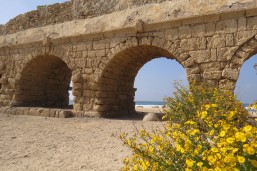
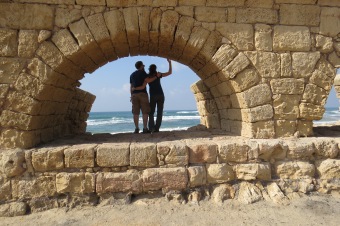
Our first stop was an aqueduct, which to the untrained eye, looked like beautiful stone archways
along a fantastic coast. Luckily Jonathan and
Bobby were there quick with the history chatter and my magical arch parade to the sea became
just a necessary mode of freshwater transit for the Romans. The water flowed at a slight decline
for 6 km along the top of this wall for years and now, the stone walls built millennia ago are slowly
disappearing into the sand. Once I found out what I was looking at, I began to think the real
craziness was coming from the fact that there were no ropes or guards keeping us off of the ruins.
In fact, people were picnicking on top of these ancient arches! It was like watching someone take
their senior pictures at the Acropolis or play frisbee at the Great Pyramid.

We continued on to explore the rest of Caesarea where we were pleasantly surprised by the huge
archaeological site. I will let the pictures do the talking, but at a glance (and so I do not forget
anything!):
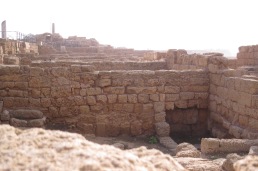
–The settlement was originally built by Herod the Great in 25 BC and was a thriving Roman
province, eventually becoming the capital of Judea. The town had a large theater,
hippodrome, bath house, and mansions – all of which we were free to explore without
much restriction or supervision.
–Paul, the Apostle was imprisoned for two years here before his fateful deportation to
Rome where he was eventually martyred.
–As with most places in this part of the world, Caesarea changed hands multiple times.
You can literally see the history in the stones. Behind this great city stood the wall and
moat built by Louis IX during the Crusades in 1251, over 1000 years later!

Caesarea was our first real introduction to ancient Israel, and I will never forget venturing over a
wall and into a tunnel, then coming out the other side to find myself standing on an awesome
mosaic I had “discovered”. I harnessed my inner Indiana Jones and shouted to Jonathan, “Look
what I have found!”

We spent the next two days exploring the coastal towns of Haifa and Akko that lie on opposite sides of a little bay.
In Haifa, we stayed with a young couple through Airbnb at a hip flat overlooking the water. Yuval, a gay, non-religious, Jewish native was an absolute wonderful host willing to answer all of my questions and explain his views of the history of the Jewish people and the current state of affairs both in Haifa and Israel as a whole. I am writing another post about my conversations with multiple Israelis both Jewish and Arab, because, as you can imagine, there is way too much to talk about and truthfully, I need time to absorb it all.
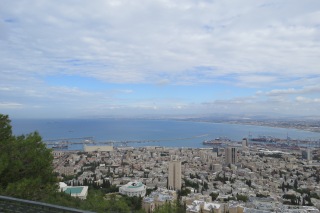
Haifa is a lovely city with the main focal point being the Bahai Gardens. Bahai is a relatively new
religion that, as one does, found its start in Israel. I felt pretty good with the main principles of
Bahai: equal rights between men and women, all religions are really just one and the fighting can
stop, and the Golden Rule. Bahai believes in all of the prophets of the other main religions
including Abraham, Jesus, Buddha, Vishnu, and Mohammed and then adds an additional two,
The Bab and Bahaullah. The gardens were gorgeous during daylight, but spectacular at night.


We headed to Akko and with no real plans, parked, climbed the walls into the old city, and started
our general theme of exploring alleyways and narrow streets. We came across a tour that took us
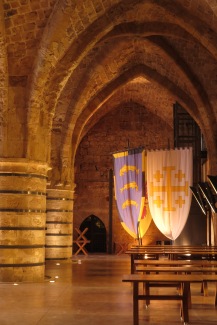
through well-preserved crusader castles, tunnels, and great halls. Akko, changed hands from the crusaders to the Mamluks and there was even an attempted takeover by Napoleon! This fertile land between continents has millennia of contestation – and we haven’t even traveled to Jerusalem yet!

Finally, our trip through the North ended in Nazareth. Unlike the other cities we have visited,
Nazareth is primarily Arab split between a small Christian population and Muslims. I had my first
encounter with the racial tension here after telling Jewish Israelis about our plans to visit Nazareth
and getting raised eyebrows and “why would you want to go there?” in return. However, just as I
expected, we had a great time in this ancient city! Driving through the narrow steep streets was
an adventure requiring Bobby and Jonathan’s guidance and help from multiple Nazarenes as we
encountered dead-ends and countless games of “chicken” with two cars trying to pass each other in alleys barely large enough for one to pass through. But we made it to an incredible hostel built over 200 years ago and spent an evening of cooking and drinking with Amir, a native of Nazareth and Ben, a German traveler. Again, our conversation will be included in a later post as I piece it all together in my mind.


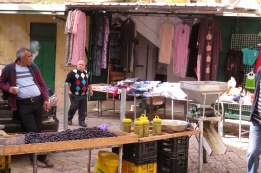
The next day, Amir took us on a tour of his city introducing us to restaurant chefs, carpenters, and spice shop owners. We tasted candied chickpeas, watched a chef prepare Qatayef (a sweet
dumpling served during Ramadan), absorbed the smells of the huge bags and baskets filled to the
brim with spices, and ended by decompressing over a warm cinnamon and walnut drink that takes days to make.
This is a town that is rebuilding from a difficult and dangerous past and desperately
trying to recreate an inviting destination for tourists. I left feeling warm towards Nazareth and
hoping the best is yet to come for the town -though should we return, I will let Jonathan drive 🙂

It has been a wonderful start to this trip with enlightening conversations, troubling thoughts,
overwhelming smells, and an ever growing appreciation for the company I have with me. Shalom.


You paint such a wonderful picture, Tracy! Thanks for all of your great words and photos.
LikeLike
Tracy this is incredible! I can only imagine what it feels like to see and touch so much history! Beautiful region and I’m glad everything is going smooth and safe! Don’t scare the natives with your singing though! Thanks for the narratives (and yes, probably let Jonathan drive!) Chris
LikeLike